Many doctors in Islamabad run a small pharmacy or medical store next to their clinic. Until now, a number of these have worked without a Drug Sale Licence (DSL). That is no longer an option.
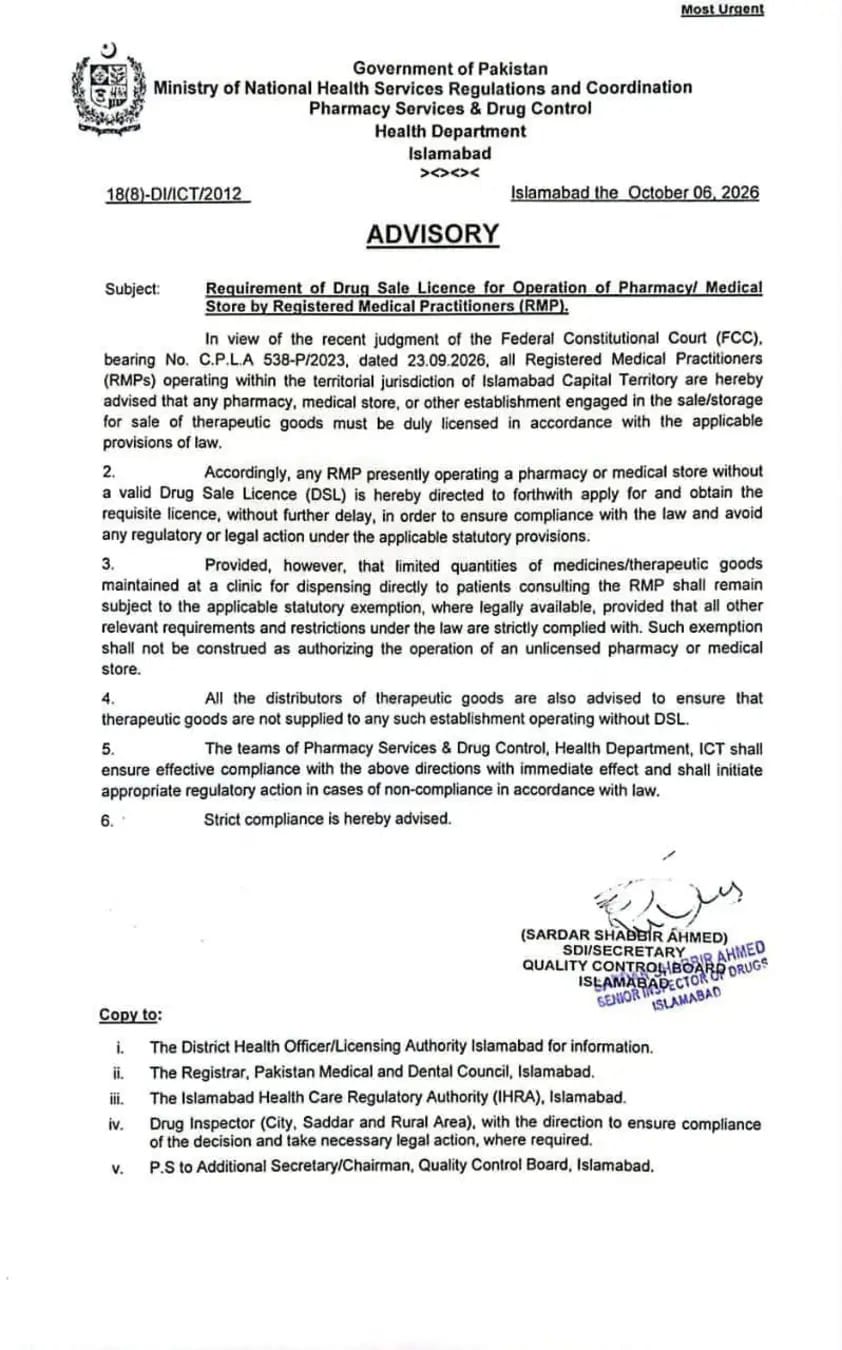
On 6 October 2026, the Pharmacy Services & Drug Control wing of the ICT Health Department issued an advisory (No. 18(8)-DI/ICT/2012), marked most urgent, addressed to all Registered Medical Practitioners (RMPs) working in Islamabad Capital Territory.
Why now
The advisory follows a judgment of the Federal Constitutional Court in C.P.L.A 538-P/2023, dated 23 September 2026. In light of that judgment, any pharmacy, medical store or other establishment that sells or stores therapeutic goods for sale must hold a licence under the applicable law.
What the advisory says
- Any RMP operating a pharmacy or medical store without a valid DSL must apply for and obtain one forthwith.
- Limited quantities of medicines kept at a clinic for dispensing directly to the doctor’s own patients remain under the statutory exemption, where it legally applies, provided all other legal requirements are met.
- This exemption does not permit running an unlicensed pharmacy or medical store.
- Distributors must not supply therapeutic goods to any establishment operating without a DSL.
- Drug inspectors (City, Saddar and Rural Area) have been directed to ensure compliance and take legal action where required, with immediate effect.
Clinic dispensing versus a medical store
The key line is between dispensing and selling. A doctor who keeps a small stock to give to patients seen in consultation is dispensing. A counter that sells medicines to anyone who walks in, or to patients on prescriptions from other doctors, is a pharmacy or medical store and now needs a DSL. Once distributors stop supplying unlicensed outlets, an unlicensed store will also lose its supply chain.
Practical examples
Allowed under the clinic exemption (no DSL needed, if all other legal requirements are met):
- A GP sees a patient with a chest infection and hands over a full antibiotic course and paracetamol from the clinic’s own stock.
- A clinic keeps an emergency tray (adrenaline, hydrocortisone, oral rehydration salts, nebuliser solutions) for patients being treated on site.
- A doctor gives injections, drips or dressings during the consultation, using clinic stock.
- A paediatrician gives a few days of syrups to a child examined in the clinic, recorded against that visit.
Needs a DSL (counts as a pharmacy or medical store):
- A counter in the clinic sells medicines to walk-in customers who have not been seen by the doctor.
- The clinic fills prescriptions written by other doctors or hospitals.
- Shelves display medicines, supplements or skin products for open sale.
- Medicines are sold in bulk or for months at a time, beyond what the consultation needs.
- A separate store front, run by an assistant, operates under the doctor’s name.
The advisory does not fix a number for “limited quantities”, so keep clinic stock small and in proportion to daily patient load, and keep records that show each item went to a patient you examined.
What to do this week
- Decide honestly whether your setup is clinic dispensing or a medical store.
- If it is a store, apply for a DSL with the ICT licensing authority without delay.
- If it is clinic dispensing, keep stock limited, keep purchase invoices from licensed distributors, and keep a dispensing record linked to patient visits.
- Check storage conditions, expiry dates and the record of any controlled medicines.
Copies of the advisory have gone to the District Health Officer/Licensing Authority Islamabad, the Registrar PMDC and the Islamabad Health Care Regulatory Authority (IHRA), so inspections can be expected. The advisory applies to Islamabad Capital Territory; doctors in the provinces should check the position with their own drug control authority.
This post is for information only and is not legal advice. Refer to the original advisory and the licensing authority for the final position.