
Aesthetic clinics and weekend Botox and filler courses have grown fast in Pakistan. Many doctors with only an MBBS or BDS now offer these procedures after a short course or an online certificate. Two regulators have spoken on this. PM&DC decided in 2024 what counts as a qualification in Aesthetic Medicine. In October 2026, the Punjab Healthcare Commission (PHC) issued a caution on aesthetic trainings and procedures at healthcare establishments. This post explains both and what they mean for you.
The short version
- PM&DC treats Aesthetic Medicine as a postgraduate specialty with at least two years of structured training. A short online certificate is not that qualification.
- PHC now expects every aesthetic workshop in Punjab to have PMDC-credentialed trainers, eligible participants, an approved curriculum and a recognised certificate.
- Clinics that perform aesthetic procedures need proper equipment, infection control, emergency arrangements, informed consent and follow-up, including for live models used in training.
- PHC has warned of strict regulatory action against facilities that do not comply.
PM&DC’s decision (December 2024)
The National Medical & Dental Academic Board discussed aesthetic practice by MBBS/BDS doctors on 12 September 2024. Board members were concerned that doctors were starting aesthetic practice after short online certifications, often with no clinical residency. The Council approved the Board’s decision in its 11th meeting on 22 October 2024. PM&DC then sent it to all universities, provincial health departments and healthcare commissions through Letter No. 1-PG/CPSP/Universities/DAI’s/2436, dated 13 December 2024.
The decision has four parts:
- A specialty, not a stand-alone certificate. Aesthetic Medicine follows the same registration pathway as other postgraduate specialties.
- At least two years of training. Any qualification in Aesthetic Medicine must include a minimum of two years of structured training.
- Curriculum first. An institution that wants to offer the qualification must first write a detailed curriculum covering everything the practice needs.
- PM&DC recognition. The institution then applies to PM&DC, which assesses the programme under its normal rules for postgraduate qualifications.
PHC’s caution (October 2026)
On 23 October 2026, the Punjab Healthcare Commission issued a caution marked most urgent. It covers any healthcare establishment (HCE) or trainer that runs or plans aesthetic procedure training in Punjab, and every aesthetic, cosmetic and regenerative procedure performed at an HCE.
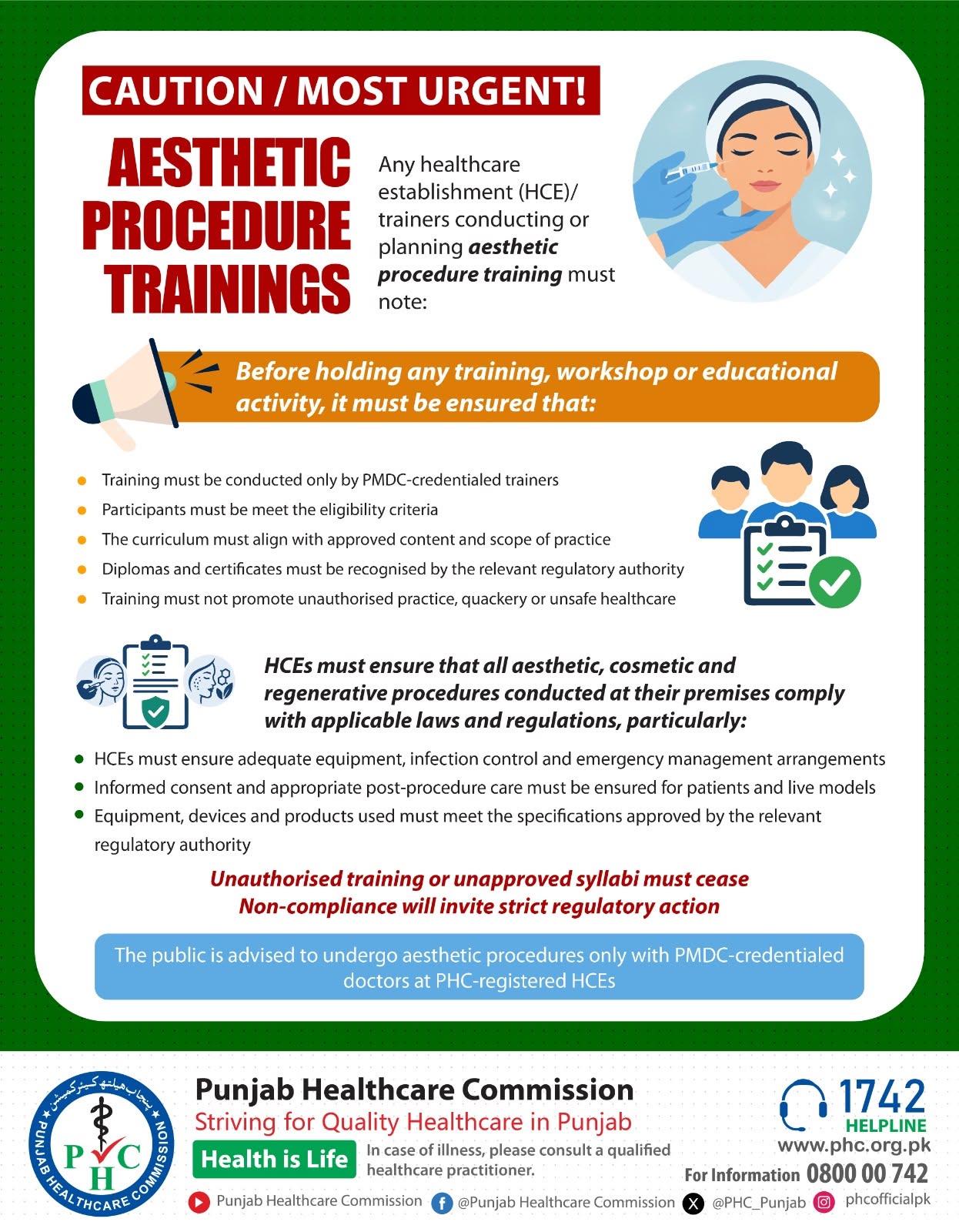
Before any training, workshop or educational activity, the HCE must make sure that:
- trainers are credentialed by PMDC;
- participants meet the eligibility criteria;
- the curriculum matches approved content and scope of practice;
- diplomas and certificates are recognised by the relevant regulator; and
- the training does not promote unauthorised practice, quackery or unsafe care.
For procedures done at the HCE, PHC expects adequate equipment, infection control and emergency management, informed consent and proper post-procedure care for both patients and live models. Equipment, devices and products must meet the specifications approved by the relevant regulator.
The consequences are clear. Unauthorised trainings and unapproved syllabi must stop, and non-compliance will invite strict regulatory action. PHC has also advised the public to have aesthetic procedures only from PMDC-credentialed doctors at PHC-registered HCEs.
How the two fit together
PM&DC and PHC regulate different things. PM&DC decides who is qualified and which postgraduate programmes are recognised. PHC licenses and inspects the clinic or hospital in Punjab where the work happens. The PHC caution rests on PM&DC’s role: it asks for PMDC-credentialed trainers and recognised certificates, which is the standard PM&DC set in 2024. A course or certificate that PM&DC does not recognise is now a problem at two levels, for the doctor and for the facility that hosts it.
PHC is also active in this area. In September 2026 alone, its inspections covered 143 aesthetic clinics in Punjab.
What this means for you
If you are an MBBS or BDS doctor thinking of aesthetics
- Before paying for a course, ask two questions: is the trainer credentialed by PMDC, and is the certificate recognised by PM&DC?
- A short course can build skills, but it does not give you a postgraduate qualification in Aesthetic Medicine.
- If you want aesthetics as a career, look for a PM&DC-recognised postgraduate programme of at least two years, or a related specialty such as dermatology or plastic surgery.
If you run a clinic that offers aesthetic procedures or hosts workshops
- Check and keep a copy of every trainer’s PMDC registration, and the approval status of the curriculum and certificate, before you host a workshop.
- Admit only eligible, qualified practitioners to hands-on sessions.
- Treat every live model as a patient: register them, take written informed consent, record the procedure and arrange follow-up.
- Keep an emergency kit and a written protocol for complications of injectables.
- Advertise only the services you actually provide, done by people qualified by law.
These points also overlap with PHC’s Minimum Service Delivery Standards (MSDS) on consent, records, infection control and emergency preparedness. If your clinic is due for a PHC inspection, see our MSDS guide for clinics.
Official documents and contacts
- PM&DC letter of 13 December 2024
- PHC caution of 23 October 2026
- PHC helpline 1742; information 0800 00 742; phc.org.pk
- PM&DC: pmdc.pk
Rate this article
How useful was it for you?
UPMED reads every review; some are shown on this page.
Log in to write a few lines too.