
A debate is currently underway regarding the recent central induction policy in Punjab, which suggests that foreign graduates will receive more benefits due to their higher degree marks compared to Pakistani graduates. Therefore, it was better to check the old data, especially the June–July 2025 induction. For this purpose, the Gazettee dataset from that induction was reviewed again after updating, merging and cleaning the records. No side is being taken, and the numbers are simply being described.
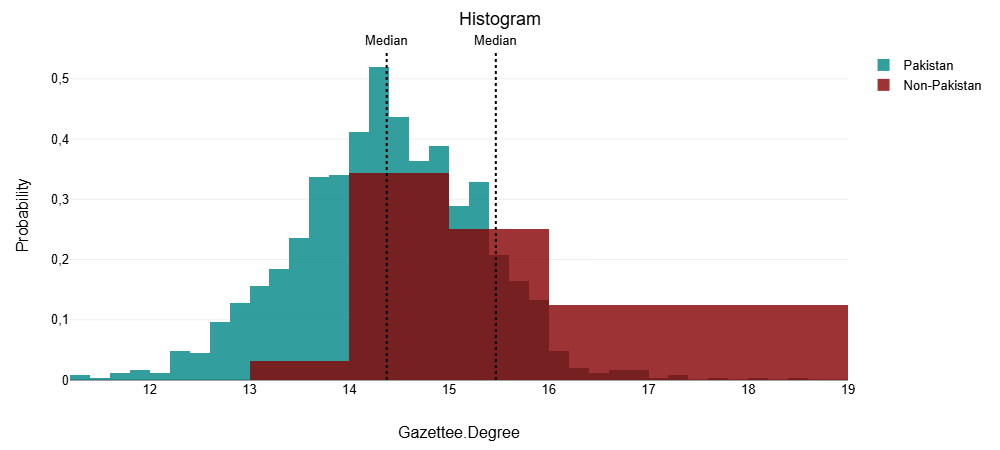
In the updated dataset, 1,252 entries were found for graduates from Pakistan, and 32 entries were found for graduates from abroad. For Pakistani graduates, the lowest marks recorded were 11.30, and the highest were 18.55. Most Pakistani scores were observed to be around 14 to 15, with an overall average of 14.38. The marks typically stayed close to this value, as the spread was small (standard deviation 0.93). For foreign graduates, the marks ranged from 13.71 to 18.44, with most scores falling within the 15-17 range. Their average was 15.80, and their scores had a slightly wider spread (standard deviation 1.49).
When both groups were compared, the foreign graduates showed higher average marks in this dataset. A two-tailed independent t-test confirmed that the difference between the two groups was statistically significant, with a p-value of less than 0.001. This means the difference did not appear by random chance, although no judgment or interpretation is being made beyond the numbers.
Disclaimer: This analysis only describes the data from the June–July 2025 induction and does not take any side. No judgment, preference, or conclusion about policy, institutes, or graduates is being made; the numbers are shared purely for informational purposes.
A simple regression analysis was also performed to determine the extent to which the difference in degree marks was attributed to studying in Pakistan or abroad. Approximately 5.17% of the variation in marks was attributed to institute type, and the overall model was statistically significant. The regression showed that foreign graduates, on average, had about 1.42 marks higher than Pakistani graduates in this sample.
The following histogram shows that most Pakistani graduates scored around the mid-14 range, while foreign graduates clustered higher, mostly above 15. The two dotted lines mark the median of each group, clearly showing that the foreign group’s central value lies to the right of the Pakistani group.
These findings do not represent the quality of any university or country. They only reflect the pattern that appeared in the June–July 2025 dataset. The results are descriptive and should not be used to generalise beyond this specific induction cycle.
Subscribe to Regular WhatsApp Updates
If you want to receive the latest updates on WhatsApp; then click this link to be added to our list. You will be able to see all the updates on our WhatsApp Statuses or send a WhatsApp message to 03042397393.
Online Medical Bookshop
If you want to order medical books online, you can order at https://shop.upmed.net/ or send a WhatsApp message at +92-323-1976177