
It was a busy Monday at a small clinic in Sheikhupura. Around eleven in the morning, the laboratory assistant reached for a one litre bottle of concentrated sodium hypochlorite kept on the top shelf. The bottle slipped, struck the floor and split open. Within a minute, a sharp smell had filled the room and the patients in the adjoining waiting area began to cough.
The cleaner arrived with a mop and a bucket of water. The doctor opened the windows and asked the patients to step outside. Nobody asked for gloves, because nobody knew where they were kept, and nobody asked for a spill kit, because the clinic had never bought one. The floor was cleaned in about an hour. Two staff members complained of burning eyes for the rest of the day, and the incident was never written down.
Events of this kind are common and usually forgotten. The Punjab Healthcare Commission (PHC) has now issued an awareness advisory on spill management for healthcare establishments, and almost every step it describes was missing that Monday.
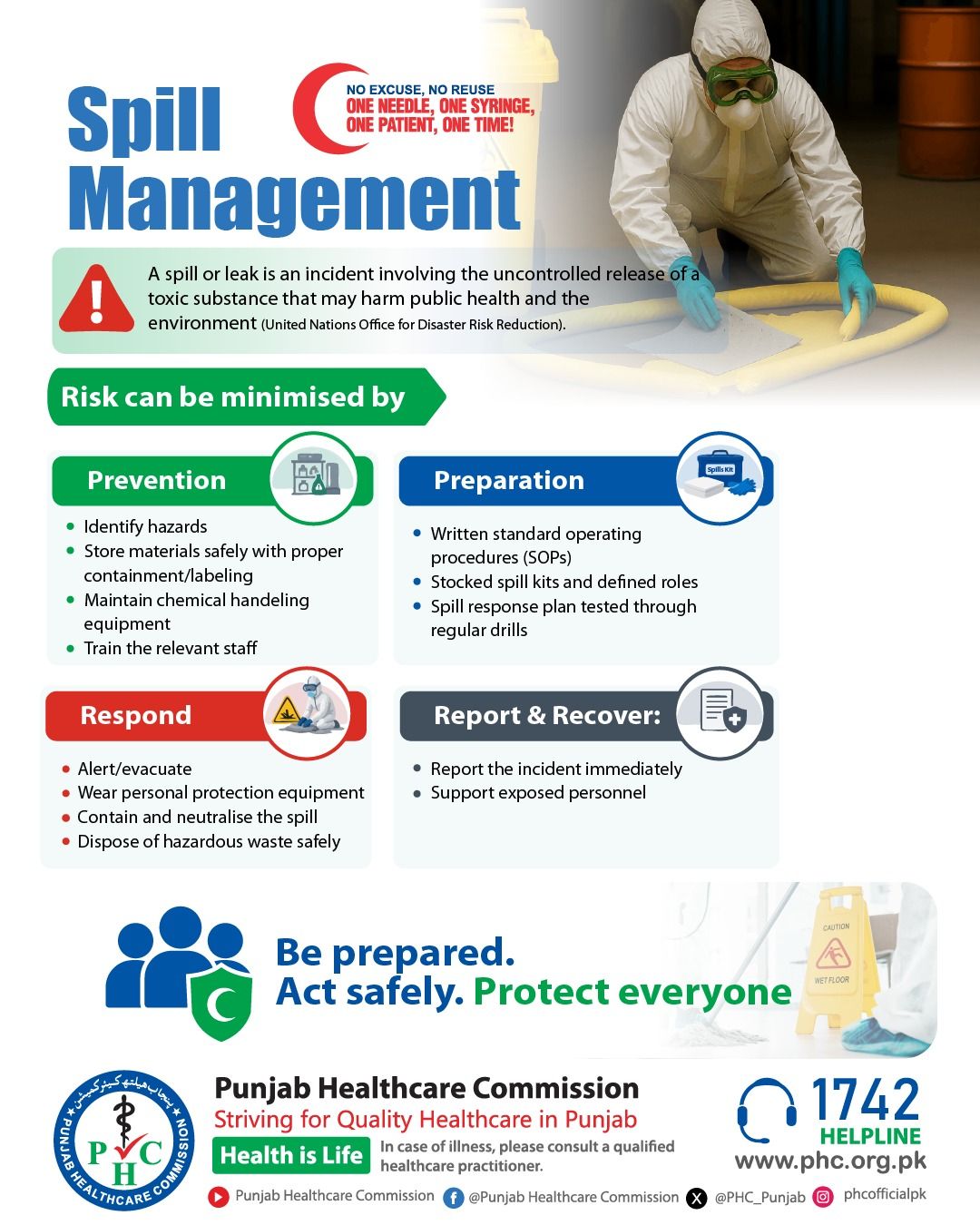
What counts as a spill
PHC uses the definition of the United Nations Office for Disaster Risk Reduction: a spill or leak is the uncontrolled release of a toxic substance that may harm public health and the environment. In a clinic or hospital, this includes disinfectants such as hypochlorite, laboratory reagents, formalin, mercury from a broken thermometer or sphygmomanometer, cytotoxic and other hazardous medicines, and blood or body fluids. The advisory groups risk reduction into four steps.
Prevention
The bottle in Sheikhupura was unlabelled, kept at head height and stored next to a patient area. PHC advises that hazards are identified, that materials are stored safely with proper containment and labelling, that the equipment used for handling chemicals is maintained, and that the relevant staff are trained. In practice, concentrated chemicals are kept on low, stable shelves in labelled, closed containers, away from patients, and are diluted only in the quantity needed for the day.
Preparation
Preparation means written standard operating procedures, a stocked spill kit, defined roles, and a spill response plan that is tested through regular drills. A basic kit usually contains gloves, goggles, a mask and an apron, absorbent pads or granules, a scoop, a leak-proof waste bag and a warning sign. It is kept in a known place, its contents are checked periodically, and every staff member knows who leads the response.
Response
The mop and the bucket of water spread the chemical over a wider area and exposed the cleaner without protection. The advisory sets a different order: alert and evacuate the people nearby, wear personal protective equipment, contain and neutralise the spill, and dispose of the material as hazardous waste. Containment begins at the edges and moves inwards, and the used absorbent goes into the hazardous waste stream, not the general bin.
Report and recover
The last step is to report the incident immediately and to support the personnel who were exposed. The two staff members with burning eyes needed eye irrigation and a medical review, and the event needed an entry in the incident register with its cause and the corrective action taken. A recorded incident becomes a lesson for the facility; an unrecorded one is simply repeated.
How it connects with MSDS
Spill management is not a separate standard, but it is examined across several MSDS indicators: arrangements for fire and non-fire emergencies with staff training and annual drills, infection control plans, appropriate consumables and waste handling systems, and training of staff who handle medical waste. For clinical laboratories, the manual goes further, as assessors look directly for disinfectants and spill kits, documented incident reports and biosafety SOPs. A facility that can show a labelled store, a stocked kit, a written procedure, a drill record and an incident register is in a strong position on all of these.
A week after the incident, the Sheikhupura clinic bought a spill kit, labelled and relocated its chemicals, wrote a one page procedure and held a fifteen minute drill with all its staff. The cost was small. The next spill, whenever it occurs, will take minutes rather than an hour, and nobody will reach for the mop first.